San Joseph Ricotta Pastry
(“Sfingi di San Giuseppe” – “Sfinci ri San Ciuseppi”)
Spring Equinox (from the Latin: equus
meaning equal and nox
meaning night) occurs around March 20th when the earth’s
axis is positioned perpendicularly to the rays of the sun and day and night have the same
duration.
Astronomic observations of the movements of the
sun were made in pre-historic times and they gave origin to
ancient pagan rituals, traditions and magic; the Sun was accepted as a deity and worshiped to gain his blessings
and his generosity.
Spring Equinox marked the end of winter and the time to prepare for the new season, to care for the land and do all
necessary planning for that time of year.
On the previous night of the Spring Equinox, it was tradition to collect pieces of wood, or anything else that
would burn and form a pile to burn for the whole night: and burn, along with it, all the misery of the past year,
welcoming the new season.
This tradition was carried out since primeval times, all over the known world as far north as the Vikings in
Europe, as far south as the African continent and as far east as Asia.
In more recent times Greeks and Romans celebrated this event with the sacrifice of lambs to the sun god for his
blessings to the land and to the seeds planted in the ground; to the goddess of fertility, Demeter for the Greeks
or Ceres for the Romans, fritters in the form of breasts of a virgin and eggs, the symbol of birth, were offered to
gain her blessings so that new life would come into their families.
Those traditions were common among the Persians, Armenians, Jews, and Germans, who at this time of the year
celebrated their own gods.
When Christianity was accepted, many of the pagan feasts endured but were transformed into Christian
holidays.
This holiday coincides with Saint Joseph's day and even at the present time all over Sicily, in particular in
Palermo, the night of March 18th big piles made of wood, old furniture and junk are burned in honor of
Saint Joseph.
This feast is celebrated in every house with a table full of bread called Pane di San
Giuseppe, along with pasta topped with fennel sauce. The wild fennels are fresh from the countryside and the
pasta is served covered with toasted breadcrumbs on top, to symbolize the sawdust in Saint Joseph carpentry.
Because at this time of the year the sardines are abundant, where they are available, they are added to this pasta
making the delicious and famous pasta con
sarde.
At this time, a creamy legume soup, the maccu di San
Giuseppe is cooked for this occasion, as it was prepared in
the pre-Christian era; it is made with a mixture of the previous year leftover dry legumes, overcooked until it
becomes mush.
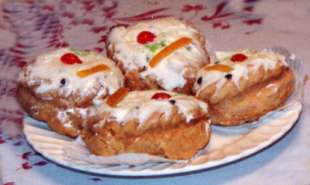
To commemorate San Giuseppe, the leavened dough, originally used to make the breasts of a virgin is
improved with eggs to make it lighter and tastier, stuffed with ricotta cream, decorated with a cherry,
symbolizing the nipple, and calledSfingi di San
Giuseppe.
MAKES 15/20 SFINGI
INGREDIENTS
For the
shells
-
2½ cups sifted
flour
-
1
½ cups water
-
2
oz. butter
-
6
medium eggs
-
Pinch of
salt
For the
Cream
-
4
cups ricotta (2 lb.)
-
1
cup granulated sugar
-
1
tablespoon semi-sweet chocolate shavings or chips
-
2
tablespoons of diced citron or assorted diced candied fruits
-
Zest of 1
orange
-
Pinch of
cinnamon
-
2
drops of vanilla
For
Frying
-
Olive Oil,
Canola or Corn Oil for deep frying
-
A
deep sauce pot for frying
For
Garnish
-
Candied orange
peels
-
Candied
cherries
-
Confectionary
sugar
PREPARATION
The Filling
Ahead of time, in a large bowl, thoroughly mix the ricotta and sugar until smooth. Blend in the zest of an orange,
cinnamon, vanilla, chocolate shavings or chips and the diced citron or assorted diced candied
fruits
Store the cream overnight in the refrigerator.
The Sfingi
Place the water, the butter and a pinch of salt in a 4 quarts saucepan with a handle and bring to a boil, stirring
occasionally.
When it boils, remove from the heat and add the flour in one shot and blend well with a wooden spoon, stirring
continuously until the flour is thoroughly mixed with the liquids.
Return to the stove on low heat, and simmer until mixture forms a ball, about 3 to 4 minutes and makes a frying
sound.
Remove from heat and transfer into a bowl, turning occasionally with the wooden spoon to cool the mixture. It takes
a few minutes.
Add one egg, and incorporate it thoroughly into the mixture before adding more eggs. Keep turning using a
whisk or a hand held electric mixer, adding the eggs one at a time. Blend well until it becomes
smooth.
The dough should be silky, thicker than pancake dough and thick enough to stand up in peaks.
Cover and rest dough for 20/30 minutes.
The frying
Use a deep pot to fry the sfingi to avoid an overflow of oil.
Bring oil at 375 degrees, dropping the mixture a few spoons at the time, without crowding the fryer. To
deposit the sfingi in the oil use the help of another spoon. Deep fry the sfingi until golden. Transfer to
drain in a dish covered with paper towels. Cool and place in a sealed container.
If the oil is too hot the sfingi will not be light or “grow” to a nice size. While frying, tap the dough with a
wooden spoon to help the sfingi expand and separate. Keep turning the sfingi to ensure they cook on all
sides.
The stuffing
Holding a sfingia in your hand, make a hole with your finger and fill the inside of it with a tablespoon of
filling. Spread a thin layer of filling over the hole and decorate with powder sugar, the orange peel, the candied
cherry and the crushed pistachio.
| 
.jpg)